Case study
Propza
Angular + Supabase product UI — auth flows, domain data, operator-grade form handling and empty states.
- Role
- Product UI · Angular
- Year
- 2025
- Angular
- TypeScript
- Supabase
- PostgreSQL
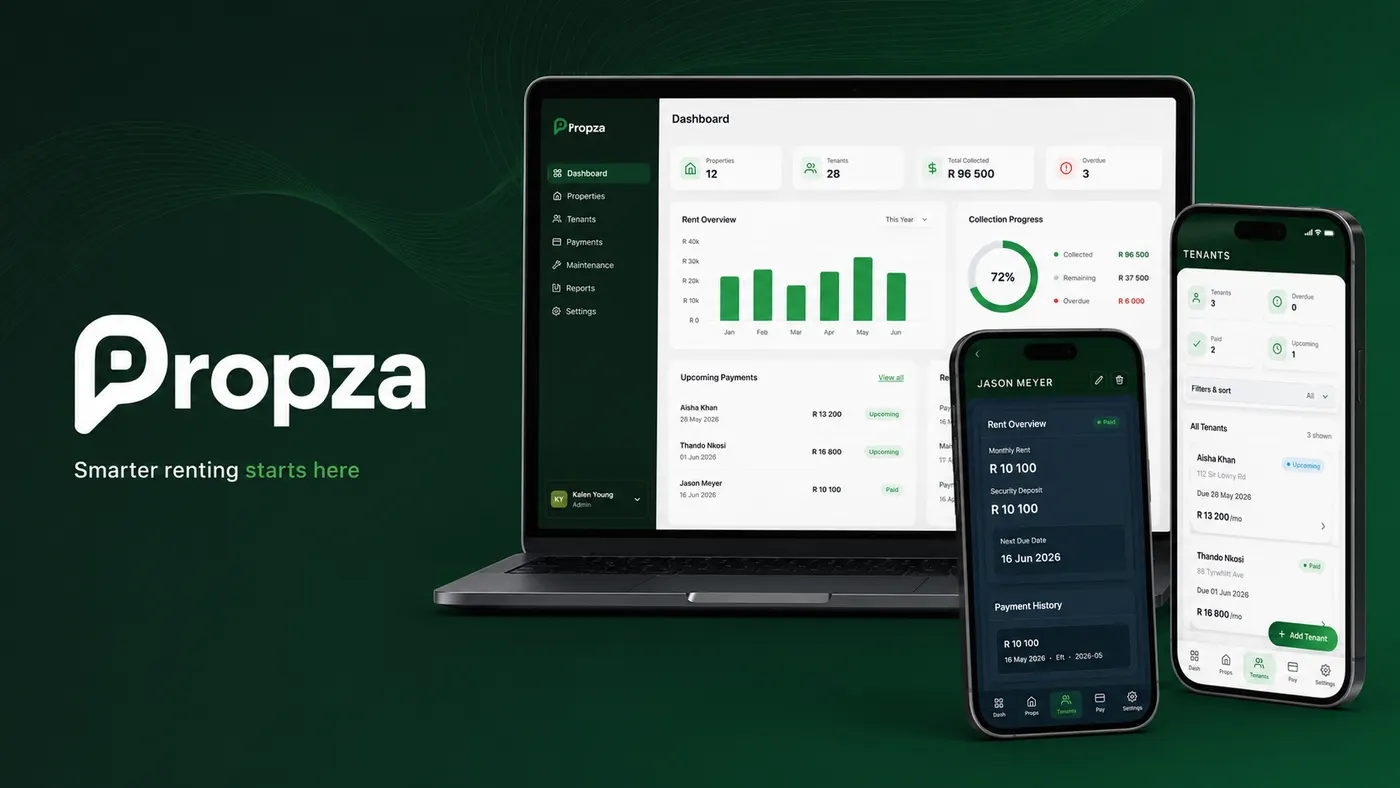
Propza is a property-management SaaS UI built end-to-end in Angular and Supabase. The brief was self-imposed and product-shaped: real domain, real auth, real data model, real empty states — the kind of surface area that separates a prototype from something a team could ship.
The domain is property management. South African landlords, ZAR, one owner with multiple properties, each property with a tenant and a running payment ledger. Simple enough to scope, complex enough to surface real problems.
The data model
The schema is three core tables. properties is the primary asset, owned by the authenticated user via owner_id. tenants hangs off properties with a CASCADE delete. payments records rent by property_id and period (YYYY-MM).
Two more tables exist in practice but not cleanly in migrations. profiles stores display name, theme preference, and notification settings keyed to auth.users.id. There’s no CREATE TABLE migration for it in the repo. RLS policies for it are wrapped in IF EXISTS, which means a fresh project fails silently. That’s a known issue and it’s documented. tenancies is a legacy table that still gets written to during the add-property flow but has largely been superseded by tenants. It needs deprecating.
One of the more interesting schema decisions was around partial payments. Migration 002 added a UNIQUE(property_id, period) constraint, one payment per property per month. Migration 006 dropped it to allow partial payments. The app had to adapt: the payment form aggregates partials, and the property detail view had retry logic that would increment the YYYY-MM period on a 23505 duplicate-key error, left over from the one-payment-per-period era.
Auth
Email and password sign-in and sign-up, Google OAuth, and password reset via email. No magic link, no multi-role RBAC. Isolation is handled by owner_id plus RLS, not application-level roles.
AuthService uses Angular signals for session state. Guards are functional CanActivateFn using inject(). The authGuard waits for the initial getSession() call to resolve before evaluating, so a hard refresh doesn’t flash the login screen for authenticated users.
There’s a beta gate, which is friction-only. A 6-digit code, base64-compared against an env variable, stored in localStorage. It’s documented as not being a real security boundary. Anyone in DevTools can bypass it in under a minute.
The RLS setup has a real issue worth calling out. Migrations 001 and 003 created permissive policies scoped only to auth.uid() IS NOT NULL. Migration 004 added the correct owner-scoped policies but never dropped the old ones. Postgres ORs policies, so if both sets are active, cross-tenant data leakage is possible on SELECT. Migration 008 hardened payments specifically by dropping all payment policies and recreating a strict set. The other tables still need the same treatment.
Forms
The most complex form in the app is the add-property modal. It handles address fields, rent amount, an “occupied” toggle that conditionally shows tenancy fields, a custom ZA date picker (dd/mm/yyyy display with a hidden native input underneath), an optional lease file upload to Supabase Storage, and a “currently paid” toggle that records an initial payment row. On submit it chains inserts across properties, tenancies, tenants, and optionally payments, with per-step error toasts if any write fails partway through.
The add-tenant modal follows a similar pattern: vacant-property picker, auto-filled rent amount from the selected property, optional contact validators, and the same “currently paid” path.
Password reset listens for the PASSWORD_RECOVERY event from onAuthStateChange, with an 800ms session fallback for cases where the event fires before the listener is ready. Small detail, but the kind of thing that breaks in production if you don’t handle it.
Both modals use reactive forms with FormBuilder. Login and the inline detail editors use template-driven forms with ngModel. The split is deliberate: reactive forms where there’s conditional logic or cross-field validation, template forms where the interaction is simpler.
Rent status logic
Rent status is computed, not stored as a static enum. RentDueService is the authoritative service: it takes a tenant’s rent_due_date and walks payment records forward to find the first unpaid period. Status comes out as paid, overdue, upcoming, or partially_paid. All date math accounts for ZA timezone (UTC+2).
There’s a second service, RentHelperService, which covers older status and period logic including weekly payment paths. The two services overlap and consolidation is on the issues list. It’s the kind of thing that accumulates when you’re iterating fast.
Empty states and guardrails
Every list has two empty states: one for no data at all (“you haven’t added any properties yet”) and one for filtered-empty (“no results match your search”). They’re different and they’re handled separately. Conflating them is a common shortcut that makes products feel unfinished.
Destructive actions use ConfirmationModalService, a promise-based modal that doesn’t dismiss on backdrop click. Delete account requires typing delete and checking an acknowledgement box. Record payment blocks submission if amount is zero, rent due date is missing, or tenant ID is absent.
SanitizationService runs on all text, address, email, phone, and notes fields before any Supabase write. It’s a single choke point for XSS and DB write safety.
Architecture
The entire app is standalone components, no NgModules. State is split between signals in AuthService and BehaviorSubject observables in PropertyService and TenantService, which subscribe to a shared refreshAll$ bus on SupabaseService. Mutations trigger refreshAll$, which fans out to both services and causes subscribed views to re-render.
All routes are eagerly loaded. That’s a known issue and a straightforward fix with lazy loading. It’s on the list.
I documented the full architecture in an interactive map, including all 17 known issues ranked by severity with remediation paths. It covers the data flows, schema, RLS timeline, and component tree. The 17 issues being visible isn’t something I’m hiding. I found them, I understand them, and I know how to fix them. That’s the point of the exercise.